Future of Smartphones and Mobile Technology
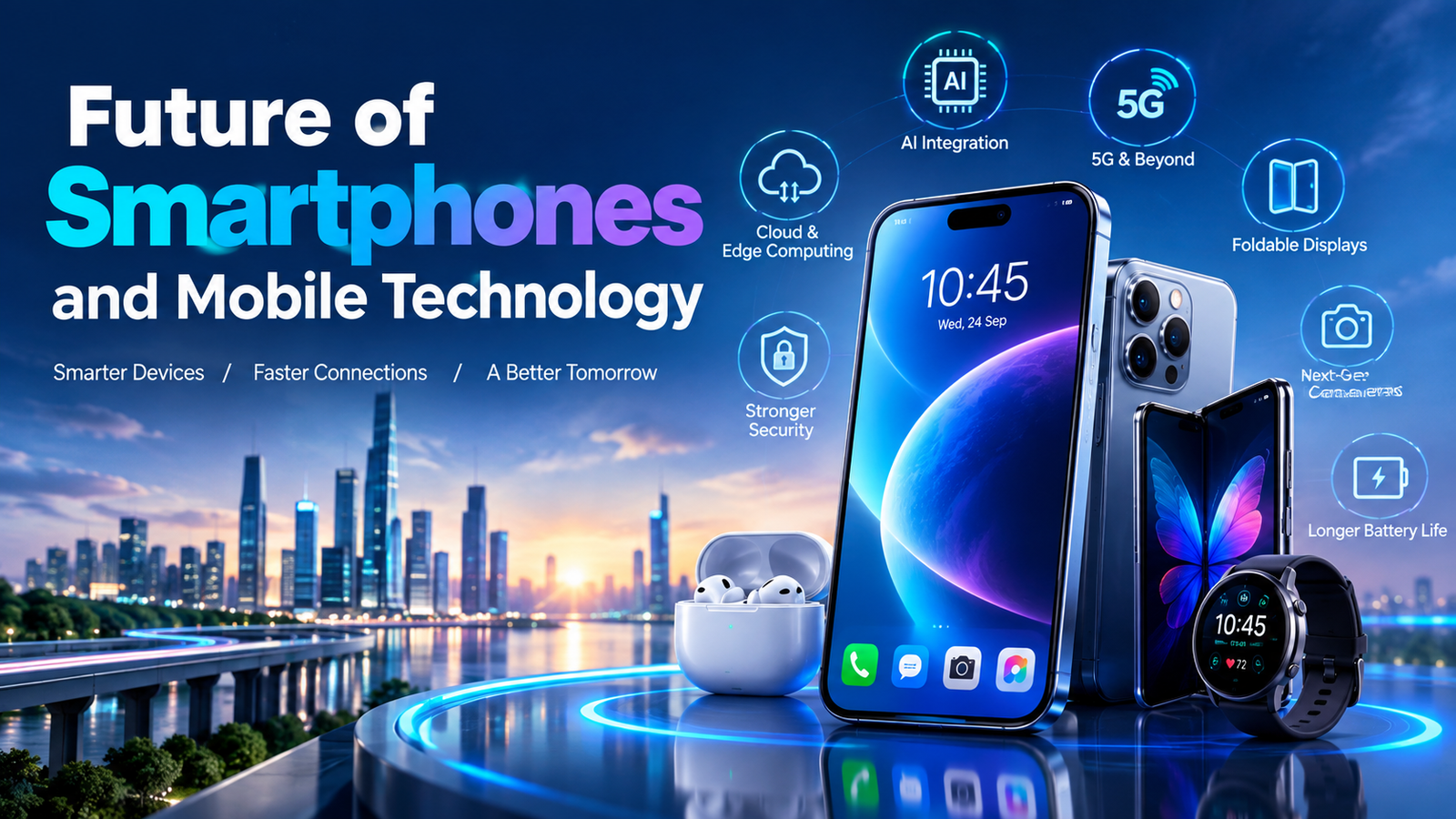
Smartphones have become an essential part of modern life. From communication and entertainment to online shopping, banking, education, and business, mobile devices are used for almost everything. However, smartphone technology is changing rapidly. With advances in artificial intelligence, faster networks, foldable displays, better batteries, and improved security, the smartphones of the future will be much more powerful and intelligent than today’s devices.
1. Artificial Intelligence in Smartphones
Artificial Intelligence (AI) will play a major role in the future of smartphones. Modern smartphones already use AI for photography, voice assistants, face recognition, and personalized recommendations. In the coming years, AI will become more deeply integrated into mobile devices.
Future smartphones may be able to understand users’ habits and automatically perform routine tasks. AI could help write messages, summarize documents, translate conversations in real time, organize schedules, improve photos, and provide personalized recommendations. On-device AI will also allow many tasks to be completed without sending information to the cloud, potentially improving speed and privacy.
2. Faster Mobile Connectivity
Mobile connectivity is another important part of the future. 5G networks are already providing faster internet speeds and lower latency, while research and development in next-generation connectivity continues.
Faster networks can make activities such as cloud gaming, high-quality video streaming, augmented reality (AR), and real-time communication smoother. Future mobile technology may also connect smartphones more closely with smart homes, vehicles, wearable devices, and other connected systems.
3. Foldable and Flexible Displays
Traditional smartphone designs may change significantly in the future. Foldable smartphones have introduced a new approach to mobile displays, allowing a device to provide a larger screen while remaining relatively compact when folded.
Future devices could feature thinner, lighter, and more durable flexible displays. Rollable or expandable screens may also become part of the smartphone market. These technologies could give users more screen space for watching videos, gaming, multitasking, and productivity without requiring a traditional tablet-sized device.
4. Better Smartphone Cameras
Smartphone cameras have developed from simple communication tools into advanced photography systems. Future smartphones are expected to continue improving image quality through better sensors, computational photography, and AI-powered processing.
Instead of relying only on larger camera hardware, manufacturers can use software and AI to improve low-light photography, portrait effects, video stabilization, zoom, and image processing. Smartphones may also offer more professional video capabilities, making mobile devices useful for content creators, journalists, and businesses.
5. Longer Battery Life and Faster Charging
Battery life remains one of the biggest concerns for smartphone users. Future mobile technology will focus on improving battery capacity, charging speeds, energy efficiency, and battery management.
Advances in battery materials could eventually provide greater energy density in smaller packages. At the same time, more efficient processors and AI-based power management could help smartphones consume less energy. Faster wired and wireless charging technologies may also reduce the amount of time users need to keep their devices connected to a charger.
6. Improved Security and Privacy
As smartphones become more powerful, security and privacy will become increasingly important. Smartphones store personal information, financial data, photographs, messages, and other sensitive content.
Future devices may use stronger biometric authentication, hardware-based security, encryption, and AI-powered threat detection. Privacy-focused features could give users more control over how applications access their camera, microphone, location, files, and personal information.
7. Smartphones and Wearable Technology
The future of mobile technology will not be limited to smartphones. Devices such as smartwatches, wireless earbuds, smart glasses, and other wearables will increasingly work together.
A smartphone may become the central hub connecting multiple personal devices. For example, smart glasses could display information while a smartphone handles processing and connectivity. Smartwatches could monitor activity and communicate with other devices without requiring users to constantly take out their phones.
8. Augmented Reality and New Experiences
Augmented Reality (AR) could transform how people use mobile technology. Instead of simply viewing information on a screen, users could interact with digital information over the real world.
AR could be useful in education, shopping, navigation, gaming, tourism, and professional training. For example, shoppers could visualize products in their homes before buying them, while students could interact with three-dimensional educational models.
Conclusion
The future of smartphones and mobile technology is likely to be defined by AI, faster connectivity, flexible displays, advanced cameras, improved batteries, stronger security, and deeper integration with wearable and connected devices. Smartphones are gradually becoming more than communication tools; they are evolving into intelligent platforms that connect people with digital services and the world around them.